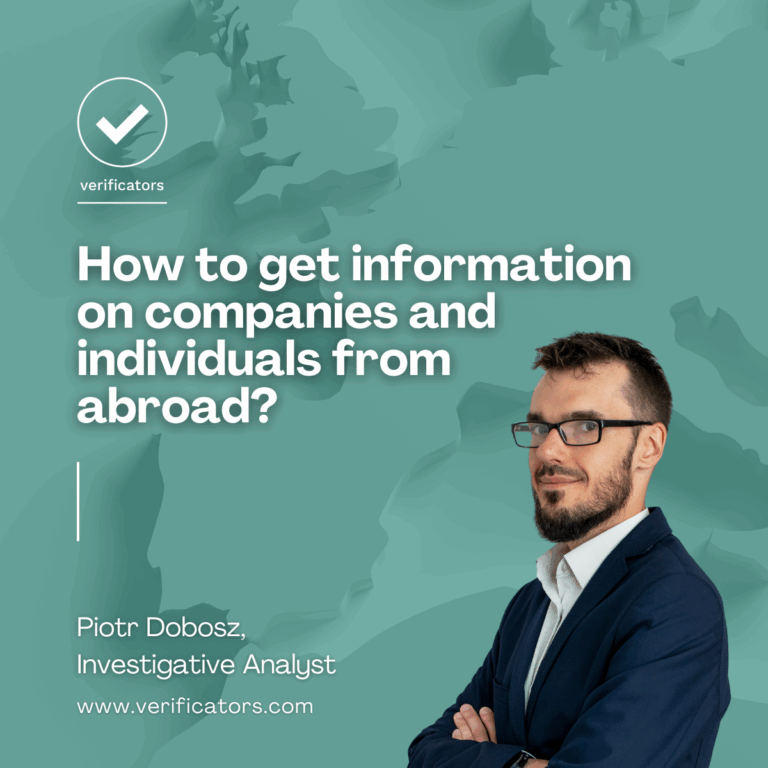
Obtaining reliable information on companies and individuals from abroad is a process that requires patience, accuracy and knowledge of the right tools. Verifying foreign contractors or business partners is essential to avoid potential legal, financial and reputational problems. Particularly in an international environment, where legal, cultural and linguistic differences can make it difficult to assess the reliability of entities, it is worth using the wide range of methods and information sources available.
Company registers and public institutions – where to look for data?
The first step is usually to reach out to official company registers. Each country has its own register, but not all of them are publicly accessible. In order to facilitate access to register data at international level, common tools have been created to integrate information from different countries, the European Business Registers Interconnection System , which also includes a business register. The portal allows you to search for information on companies registered in the registers of the EU, Iceland, Liechtenstein and Norway.
For companies outside the EU, look for the equivalent national business registers, such as the UK’s Companies House or the US’s EDGAR, where you can find basic data as well as financial statements or owner information. It is worth bearing in mind that in some countries access to the full information may require a fee or contact with local authorities.
How to verify the tax and ownership situation of a company?
Tax verification is another important step. The VIES system makes it possible to check whether a foreign partner is an active VAT payer in the European Union. This is particularly important for intra-Community transactions. If the company does not appear in the system, it is worth consulting directly with the relevant tax office in the country concerned, as sometimes the data may be out of date or the company is not registered for international transactions.
In the case of individuals and beneficial owners, registers revealing who actually controls a company are increasingly important. In Poland, there is the Central Register of Beneficial Beneficiaries, and in other countries similar databases that allow information to be accessed on individuals with real influence over the company’s operations. In some countries, such as the UK, access to this data may require a demonstrated legal interest, but in most cases the basic information is publicly available.
Professional support and local information sources
It is also worth using the services of professional business intelligence services, which, for a fee, prepare detailed reports on the financial situation, payment history, reputation and ownership links of a particular company. For companies in less transparent markets, consider working with local information providers who may have access to data that is not available to international intelligence agencies.
Modern verification methods and warning signs
Open source analysis, or OSINT, tools are playing an increasingly important role in information acquisition. Platforms such as OpenCorporates collect data on companies from multiple countries and allow quick verification of ownership links or business history. By verifying individuals, it is possible to analyse their social media presence, academic publications, press mentions or attendance at industry conferences.
When it comes to international cooperation, checking whether a company or individual is on sanctions lists cannot be overlooked. Both the US OFAC and the European Union maintain public registers of entities subject to economic sanctions. It is worth checking these lists regularly, especially in the context of working with partners in restricted regions.
Analysis of registration documents and financial statements is another step to assess the stability and transparency of a company. In many countries, companies are required to publish annual reports, which can be found in the relevant registers. Analysis of these documents makes it possible to assess the financial condition, revenue and cost structure, as well as possible links with other entities.
Business contacts and recommendations can also be an invaluable source of information. It is worth contacting chambers of commerce, industry organisations or Polish diplomatic missions, which often have access to local databases and can provide information on the reputation of a given entity. In Asian countries or the Middle East, personal recommendations and networks are particularly important and can determine the success of a cooperation.
In the vetting process, it is important to look out for any worrying signals, such as frequent changes of registered office address, lack of transparency in the ownership structure or the use of intermediaries from tax havens. Corporate relationship analysis tools, such as Orbis, allow to track global relationships between companies and catch potential risks.
Modern technologies, including blockchain-based solutions, are increasingly supporting due diligence processes, enabling transaction history and provenance to be tracked in an unalterable and transparent way. This provides greater confidence in the authenticity and reliability of the partner.
Summary – how to combine different methods into an effective strategy?
In summary, acquiring information on foreign companies and individuals requires a combination of different methods and sources – from official records to professional reports to analysis of open data and industry recommendations. The higher the value of the transaction or the longer-term nature of the cooperation, the more worthwhile it is to invest in in-depth verification. By doing so, you can minimise risk, increase business security and build lasting, trusting international relationships.
Author: Piotr Dobosz
Read other articles on our blog: